Research
AI-driven research at VIB.AI starts from biological questions and challenges that are addressed using state-of-the-art and novel computational and AI strategies. We combine in silico approaches with technology and wet lab experiments to arrive at an integrated research approach in a “humid” environment.
Our research lines cover multiple biological layers from the genome to cell function, tissues, and organisms and populations. Along the spectrum of computational modeling, we focus on representation learning, AI-explainability, and hybrid models.

Biological applications of our research are equally broad: from microorganisms to plant biology, biodiversity and ecology, neuroscience, cancer, and immunology. We also welcome applicants with applied projects, including synthetic biology, AI-driven experiments (experiment-in-the-loop), or bio-engineering.
A cross-disciplinary community
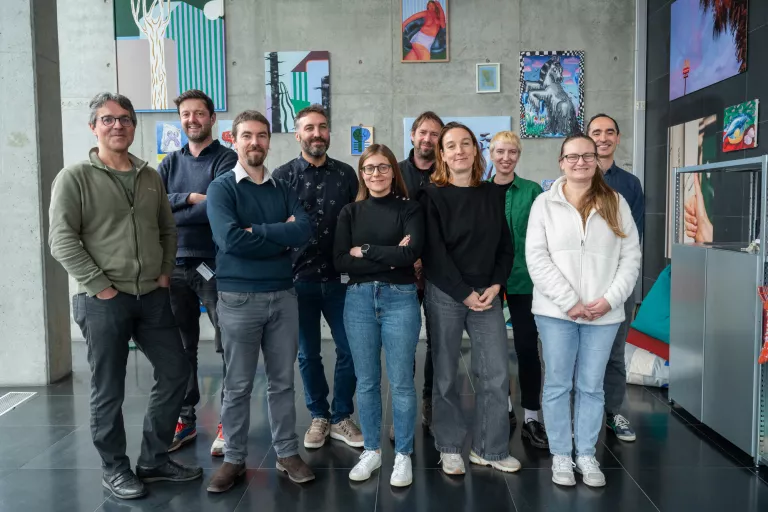
VIB.AI brings together core groups working on AI and computational biology, as well as affiliated groups across the different VIB centers with deep computational expertise.

Further reading
VIB.AI's research builds on a strong foundation of computational expertise at VIB in diverse areas of life sciences. Here you find a small selection of recent output from members of the VIB.AI community.
CREsted: modeling genomic and synthetic cell-type-specific enhancers across tissues and species
Niklas Kempynck, Seppe De Winter, Casper H. Blaauw, Vasileios Konstantakos, Eren Can Ekşi, Sam Dieltiens, Darina Abaffyová, Valérie Bercier, Ibrahim I. Taskiran, Gert Hulselmans, Katina Spanier, Valerie Christiaens, Ludo Van Den Bosch, Lukas Mahieu & Stein Aerts
JAXLEY: differentiable simulation enables large-scale training of detailed biophysical models of neural dynamics
Michael Deistler, Kyra L. Kadhim, Matthijs Pals, Jonas Beck, Ziwei Huang, Manuel Gloeckler, Janne K. Lappalainen, Cornelius Schröder, Philipp Berens, Pedro J. Gonçalves & Jakob H. Macke
Dissecting the impact of transcription factor dose on cell reprogramming heterogeneity using scTF-seq
Wangjie Liu, Wouter Saelens, Pernille Rainer, Marjan Biočanin, Vincent Gardeux, Antoni Jakub Gralak, Guido van Mierlo, Angelika Gebhart, Julie Russeil, Tingdang Liu, Wanze Chen & Bart Deplancke
Sculpting conducting nanopore size and shape through de novo protein design
Samuel Berhanu, Sagardip Majumder, Thomas Müntener, James Whitehouse, Carolin Berner, Asim K. Bera, Alex Kang, Binyong Liang, Nasir Khan [...], Anastassia A. Vorobieva
Microbiome confounders and quantitative profiling challenge predicted microbial targets in colorectal cancer development
Raúl Y. Tito, Sara Verbandt, Marta Aguirre Vazquez, Leo Lahti, Chloe Verspecht, Verónica Lloréns-Rico, Sara Vieira-Silva, Janine Arts, Gwen Falony, Evelien Dekker, Joke Reumers, Sabine Tejpar & Jeroen Raes
Decoding gene regulation in the fly brain
Jasper Janssens, Sara Aibar, Ibrahim Ihsan Taskiran, Joy N. Ismail, Alicia Estacio Gomez, Gabriel Aughey, Katina I. Spanier, Florian V. De Rop, Carmen Bravo González-Blas, Marc Dionne, Krista Grimes, Xiao Jiang Quan, Dafni Papasokrati, Gert Hulselmans, Samira Makhzami, Maxime De Waegeneer, Valerie Christiaens, Tony Southall, Stein Aerts
Unsupervised visualization of image datasets using contrastive learning
Niklas Böhm, Philipp Berens, Dmitry Kobak